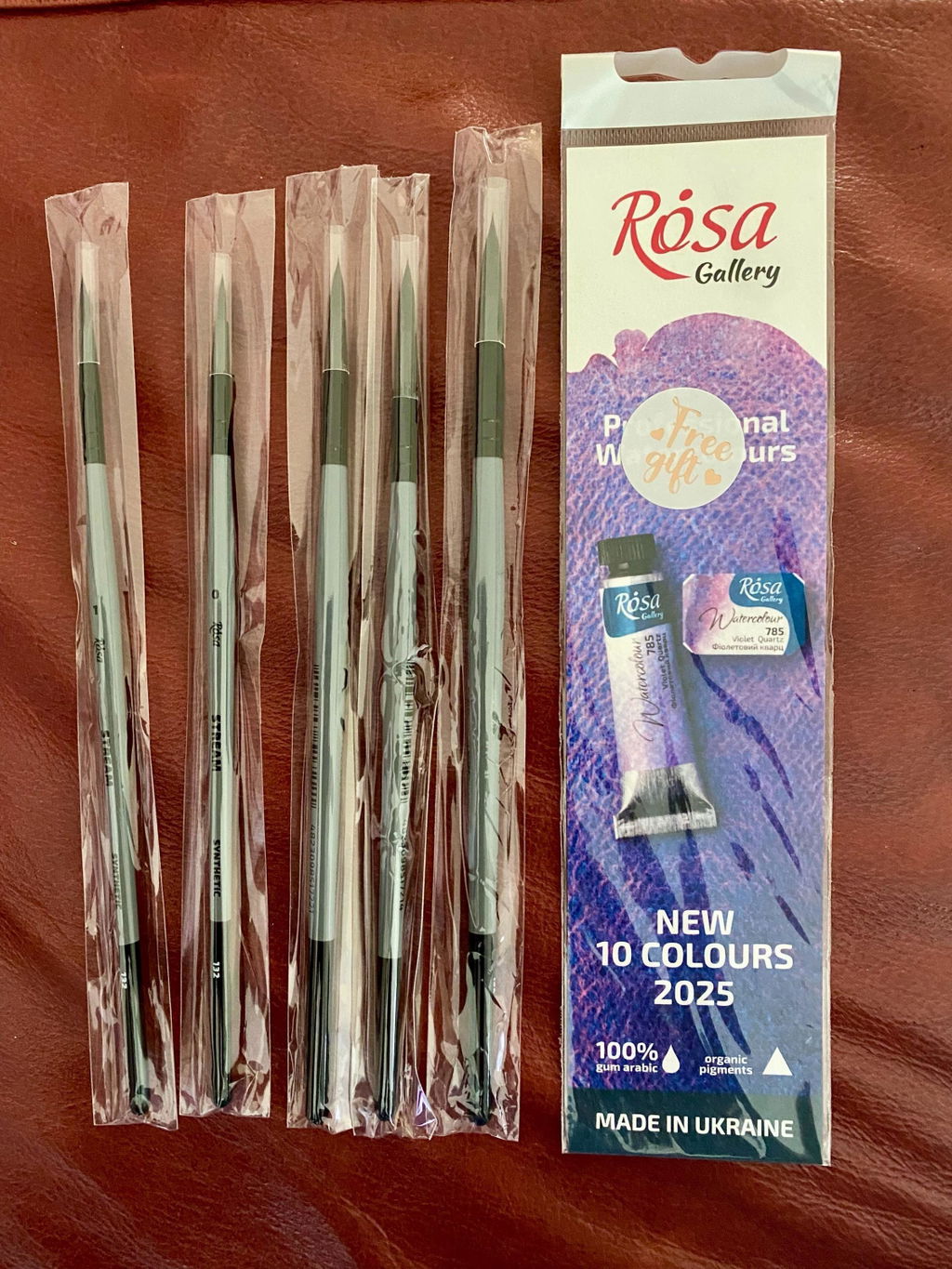
ROSA Stream 132 Watercolour Round Synthetic Brush — Sizes 0–10, Professional Artist Quality, Made in Ukraine
ROSA Stream 132 Watercolour Round Synthetic Brush — Sizes 0–10, Professional Artist Quality, Made in Ukraine
Couldn't load pickup availability
- In Stock: available for dispatch
- Free UK Delivery: orders over £40
- Free return: 30 days
A round brush is the one you reach for most, and it's also the one that disappoints most often. Cheap synthetics lose their point after a fortnight; soft natural hair holds water beautifully but collapses the moment you want a crisp edge. The ROSA Stream 132 round sits exactly between the two — springy enough to snap back into a sharp tip, soft enough to lay a smooth wash.
It's the brush for painters who want to control the stroke rather than negotiate with it.
Key characteristics
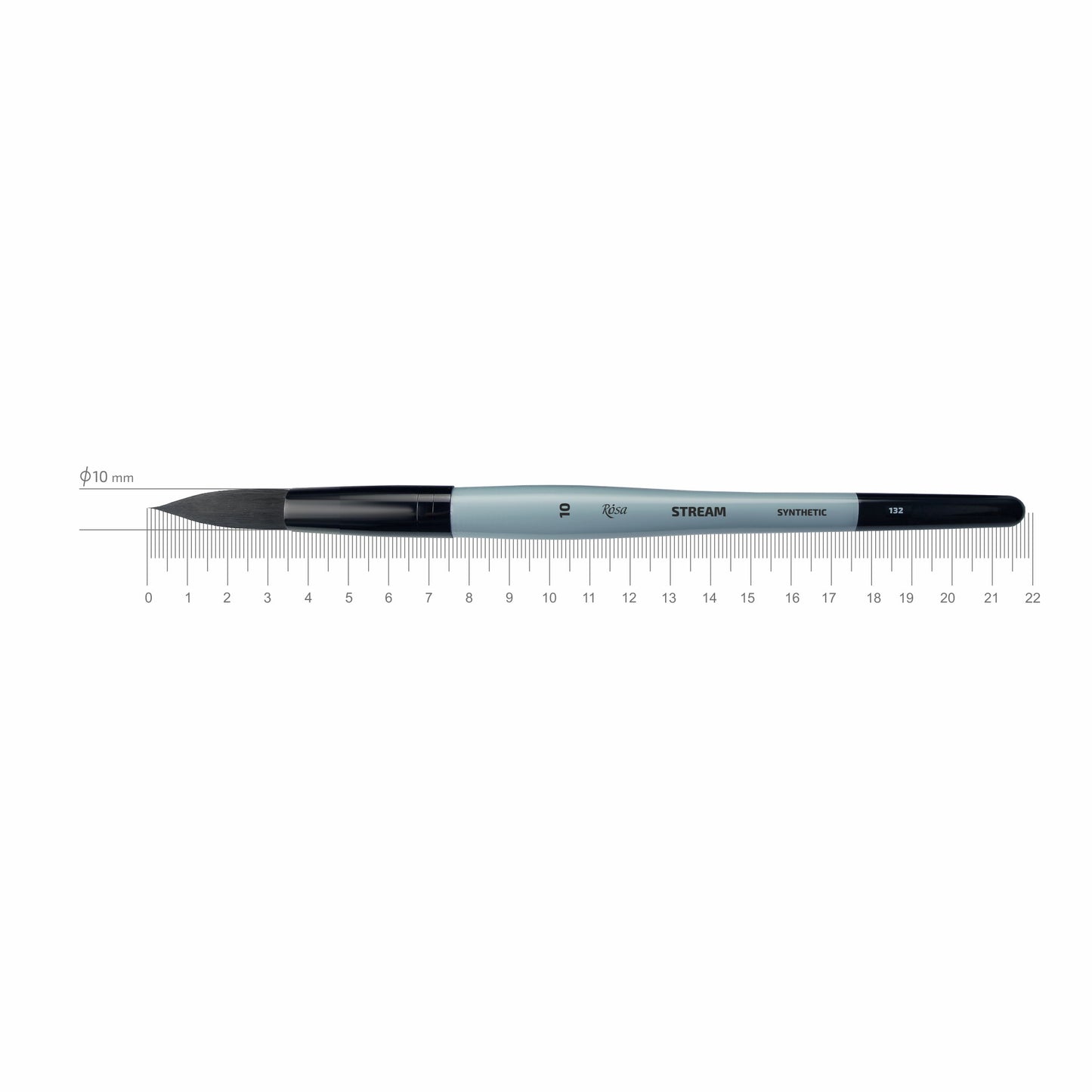
- Shape: round — the most versatile head shape, capable of a hairline and a broad wash from the same brush.
- Fibre: springy, soft black synthetic that holds its shape and its point.
- Sizes: 0 to 10, so you can build a working set or replace one size you've worn out.
- Best for: washes and fills, clean strokes of varying width, and fine detail.
- Suits: watercolour, ink, gouache and fluid acrylic.
- Made in Ukraine by ROSA, an art materials manufacturer producing professional artist tools since 1996.
Why synthetic, and why this synthetic
ROSA's synthetic fibres are more elastic and more hard-wearing than natural hair. That matters in practical terms: a natural-hair round softens with use and eventually stops holding a point, while a good synthetic keeps snapping back for far longer. If you paint most days, the difference shows up within a few months.
What separates this fibre from cheap synthetic is the balance. Too stiff and it drags on the paper, leaving streaks and refusing to release colour. Too soft and it goes limp when loaded. The Stream 132 fibre is springy but genuinely soft, which is why it can carry a full load of water for a wash and still deliver a clean tapered stroke as the brush lifts.
It also releases paint evenly rather than dumping colour at the start of a stroke — the thing that makes flat washes possible without visible tide lines.
Choosing your size
If you're buying one brush, size 4 or 5 is the honest all-rounder — big enough to fill a small area, fine enough to hold a point for detail. Beyond that:
- Sizes 0–2 — fine detail, botanical work, highlights, signatures, small textures like foliage and fur.
- Sizes 3–5 — general painting. Most sketchbook and A5–A4 work happens here.
- Sizes 6–7 — larger shapes, confident single-stroke marks, loose sketching.
- Sizes 8–10 — washes, skies, backgrounds and broad areas where you want fewer, bigger strokes.
A practical starting trio for most painters: one small (1 or 2), one medium (4 or 5), one large (8). That covers almost everything without a drawer full of brushes you never touch.
Who it's for
Watercolourists who want control. The point holds, so you can go from a wash straight into detail without swapping brushes mid-passage.
Urban sketchers and plein air painters. Synthetic recovers faster from rough treatment and doesn't mind being packed damp — natural hair is far less forgiving on location.
Botanical and illustration work. The smaller sizes hold a genuinely fine tip for stems, veins and fine linework.
Students and beginners. Good synthetic is where most painters should start. It's forgiving, it lasts, and it costs a fraction of sable while doing most of the same jobs.
Anyone rebuilding a worn set. Because sizes are sold individually, you replace the one brush that's gone rather than buying another kit.
Looking after it
Rinse in clean water while you work and don't leave the brush standing in a jar — resting on the tip is what ruins a point, on any brush at any price. After painting, rinse thoroughly, gently reshape the head with your fingers and lay it flat or hang it bristles-down to dry. Stored properly, a synthetic round of this quality stays usable for years rather than months.
A gift for someone who paints
Brushes make an easier gift than paint. There's no risk of duplicating a colour someone already owns, and every painter always needs another good round. A set of three sizes presented together makes a considered present at a modest price — and pairs naturally with any of the ROSA Gallery watercolour sets in our range.
Shipping and packaging
Dispatched from our base in Staffordshire, UK. No long international waits and no customs charges for UK buyers. Brushes are packed so the tips arrive protected and unbent — the detail most sellers skip and every painter notices.
Tracked UK delivery, with international shipping available.
Pick your size
Springy black synthetic, a point that lasts, and ten sizes to choose from. Select your size above and add it to your basket — or browse the full ROSA Stream range for liners, flats and dagger brushes.
Questions we get asked
Which size should I buy first?
Size 4 or 5. It's large enough to cover small areas quickly but still holds a fine point, so it handles most of a painting on its own. Add a smaller and a larger one as you find the gaps.
Is synthetic as good as sable?
For most work, yes — and in some ways better. Sable holds more water, but synthetic is springier, more durable and far cheaper. For sketchbook work, plein air and everyday practice, a good synthetic round is the more sensible tool.
Can I use these with acrylic or gouache?
Yes. The fibre handles watercolour, ink, gouache and fluid acrylic. Just rinse acrylic out thoroughly before it dries — dried acrylic ruins any brush.
Will the tip stay sharp?
The fibre is chosen to hold its shape and recover its point after wetting. Care matters too: never leave it standing in water, and reshape the head before it dries.
Do you sell these as a set?
These are sold individually so you can pick exactly the sizes you need. We also stock ROSA Stream brush sets separately if you'd prefer a ready-made selection.
Share


- 5 stars: 1 (100%)
- 4 stars: 0 (0%)
- 3 stars: 0 (0%)
- 2 stars: 0 (0%)
- 1 star: 0 (0%)
Good brushes & great customer service when Royal Mail made a delivery error. Thank you!